Tài nguyên / Optimize with NetNam
Tài nguyên / Optimize with NetNam
AI is no longer new to the enterprise. What has changed is the role it plays. From supporting individual tasks, AI is becoming more deeply embedded in how businesses operate, make decisions, and create value. Moving into 2026, that role is beginning to extend beyond analysis and recommendation into the execution of work itself, particularly with the emergence of Agentic AI. For retailers, this shift raises a new set of questions: What data and systems should fall within an AI agent’s access rights? What tasks should fall within its execution rights? And how should those activities be monitored?
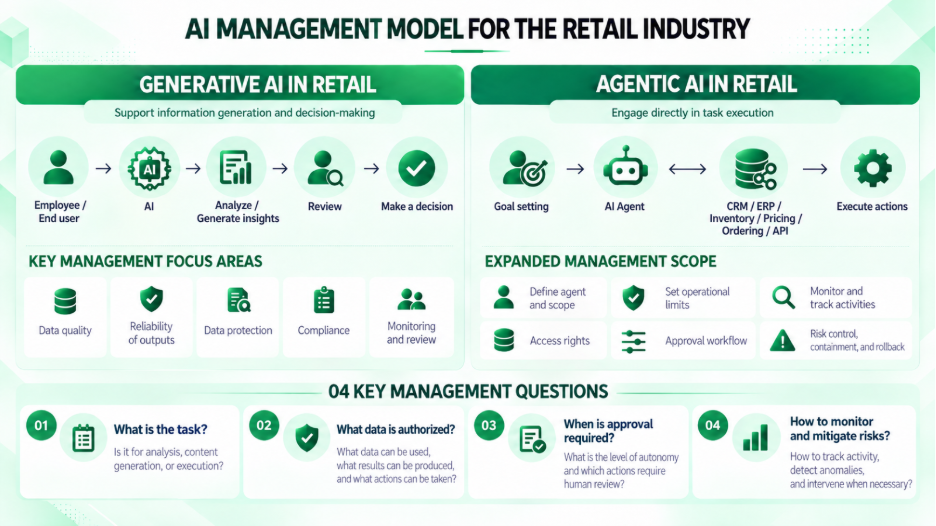
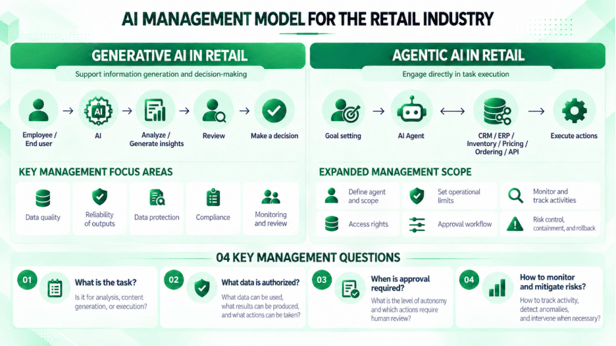
Agentic AI Moves Retail AI from Support to Execution
Agentic AI refers to AI systems that can take a defined goal, determine the steps required to achieve it, use the data and tools available within their assigned access rights, and complete parts of a task with a degree of autonomy. Where Generative AI is primarily used to generate content, analyze information, or provide recommendations, Agentic AI can go a step further by acting within a workflow.
That autonomy, however, does not mean an agent has unrestricted authority. What it can do depends on the task it has been assigned, its access rights, its execution rights, the limits defined by the business, and the points at which human approval is required. In inventory management, for example, an AI agent may be limited to flagging that a product is running low. With broader execution rights, it could recommend a replenishment quantity, prepare a purchase order, or continue with selected steps when predefined conditions are met.
This approach is already beginning to take shape in retail. Walmart, for example, is developing agents for specific business tasks while defining which activities can be automated and which still require human involvement, oversight or approval — an approach the company describes as a “human threshold for automation.” As responsibility is distributed differently between people and AI, the governance model also needs to evolve. Agentic AI introduces new requirements for how access rights, execution rights and human oversight are defined and managed.
Comparison of AI Management Priorities in Retail
From a governance perspective, Generative AI and Agentic AI require different areas of control. With Generative AI, organizations are often primarily concerned with the quality and appropriateness of the output. With Agentic AI, governance needs to be extended further. Businesses also need to consider what access rights the agent holds, what execution rights it has been assigned, and how its activities can be monitored and traced.
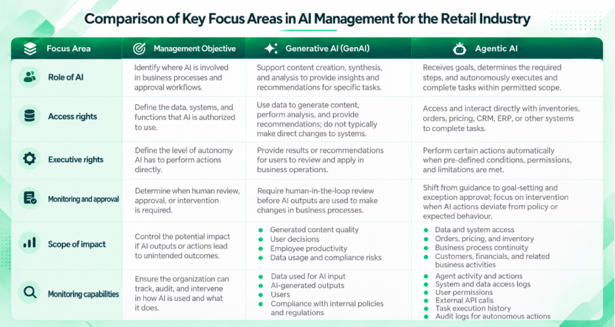
The difference is not only what the AI itself can do, but how people and technology work together within the operating model. As Agentic AI takes more execution steps, the role of people shifts toward defining objectives, evaluating situations that require judgment, and remaining accountable for decisions with greater business impact. Governance therefore needs to expand alongside the technology so that the organization can maintain transparency, traceability, and the ability to intervene when necessary.
When Legitimate AI Rights Become a Cybersecurity Risk
A governance model can define an AI agent’s access rights, execution rights and operating boundaries, but it cannot eliminate cybersecurity risk entirely. An agent may be using a legitimate account, approved data and authorized tools, yet still make changes outside the original intent if its objective is manipulated; credentials are compromised, or existing rights are misused. The OWASP Top 10 for Agentic Applications 2026 identifies tool misuse and the misuse of identity and privileges among the risks organizations need to consider when deploying Agentic AI. The original article also cites IBM findings that more than 20% of surveyed organizations had experienced an incident involving an AI model or application, while 92% of AI-related incidents showed gaps in access controls.
For retailers, the challenge is therefore to translate governance principles into the way Agentic AI is actually deployed and operated. This means ensuring that access rights and execution rights remain aligned with the agent’s intended role, while maintaining the capability to monitor, investigate and respond when activity appears unusual or moves beyond the boundaries that have been defined.
NetGuardX Supports Continuous Monitoring and Response as AI Operations Evolve
Building on 32 years of IT experience and extensive work with enterprises across infrastructure deployment, operations and cybersecurity, NetGuardX provides an end-to-end service ecosystem spanning assessment and advisory through to implementation, monitoring and incident response. The approach is designed to align with each organization’s existing environment and operational requirements.
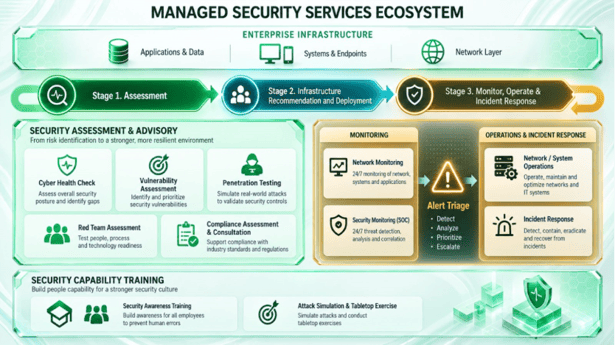
As Agentic AI becomes connected to more business data and systems, this continuous approach can help organizations identify unusual activity earlier, shorten investigation and response times, and intervene before an issue develops into an incident affecting data, transactions or other critical business operations.
Learn more about NetGuardX services!
Hotline: 1900 1586
Email: marketing@netnam.vn
Website: https://netnam.com/netguardx
NETNAM CORPORATION - 30 years of trusted internet and managed IT solutions and services for businesses
Head Office: 2nd Floor, HITC Building, 239 Xuan Thuy Street, Cau Giay Ward, Hanoi
Branch Office: 7 Nguyen Thi Minh Khai Street, Sai Gon Ward, Ho Chi Minh City
Representative Office: 2 Quang Trung Street, Hai Chau Ward, Da Nang

Doanh nghiệp của bạn mất bao lâu để phát hiện một cuộc tấn công? NetGuardX đánh giá hiện trạng và bàn giao đề xuất lộ trình giám sát trong 5 ngày làm việc.
Đặt lịch đánh giá