Tài nguyên / Compliance Corner
Manufacturing businesses typically operate within a broader ecosystem that includes a parent company or corporate group, customers, partners, and suppliers across the value chain. Each of these stakeholders may have different expectations or requirements regarding cybersecurity. In this environment, compliance is not limited to meeting regulatory obligations. It also forms part of how organizations maintain commitments to customers and partners, satisfy corporate requirements, and meet the conditions necessary to support ongoing business operations.
According to the World Economic Forum Global Cybersecurity Outlook 2026, 74% of respondents viewed cybersecurity regulation positively, while 55% said regulation had contributed to improving their organization’s security posture. Beyond meeting individual requirements at a given point in time, the compliance process can also give organizations a clearer view of their current capabilities. It helps identify where controls need to be strengthened and where improvement should be prioritized based on the realities of day-to-day operations.
Compliance Requirements Provide a Clearer View of Current Capability
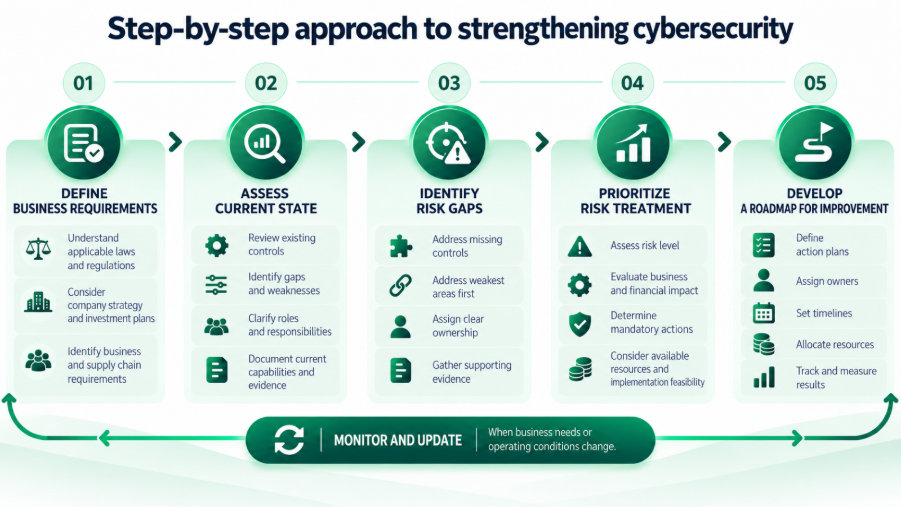
Compliance requirements typically define the areas an organization is expected to address as part of its cybersecurity operations. These may include access to management, data protection, system monitoring, and preparedness for security incidents. Understanding whether those requirements are genuinely being met, however, involves more than confirming that a policy, tool or process exists. The more important question is whether those controls are actually being applied and maintained consistently in day-to-day operations.
In practice, capability gaps often appear not because an organization has no security policies or technologies in place, but because those controls are not being sustained effectively over time. Responsibilities may not be clearly assigned. Security tools may not be monitored regularly. Incident response procedures may exist but have never been tested. Records may also be insufficient to demonstrate that controls are being applied consistently. Viewed in this way, compliance provides more than a checklist. It gives organizations a structured way to understand their current cybersecurity capability, identify areas that still need attention, and determine what should continue to evolve as operating conditions change.
Turning Identified Gaps into a Practical Improvement Roadmap
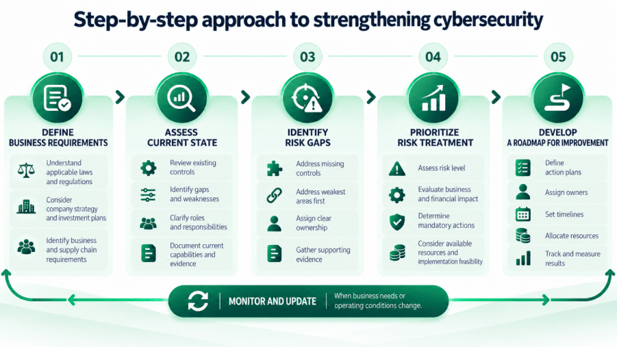
Once capability gaps have been identified, organizations need to decide what should be addressed first rather than treating every issue equally urgently. Prioritization should consider several factors together: the level of cybersecurity risk, potential impact on operations and business, whether a requirement is mandatory, and the resources available to implement the necessary improvements. From there, individual gaps can be translated into a practical roadmap with clear ownership, timelines, and a way to measure progress. This helps turn compliance findings into an actionable improvement program rather than a list of disconnected requirements
Extending the Value of Compliance into Long-Term Operational Capability
Once compliance requirements have been translated into a defined improvement roadmap, the next challenge is keeping those controls effective as the operating environment changes. Systems, people, and supply-chain relationships do not remain static. A manufacturing facility may add new equipment, introduce new network connections, change suppliers, or modify production processes. At the same time, regulations, corporate standards, and customer requirements may also evolve. A control that was appropriate at one point therefore cannot simply be assumed to remain effective indefinitely. It needs to be monitored, reviewed, and adjusted as the environment around it changes. This is where the longer-term value of compliance becomes clearer. Rather than treating compliance as a one-time exercise, organizations can use it as part of an ongoing process for assessing whether cybersecurity controls continue to support both current operational needs and evolving business requirements.
As a cybersecurity partner, NetGuardX provides a service ecosystem that supports organizations throughout the process of strengthening their cybersecurity capabilities — from assessing the current environment and defining improvement priorities to implementation, monitoring and maintaining effectiveness during ongoing operations.
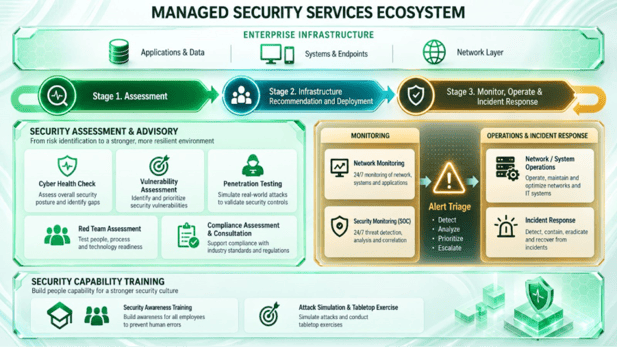
This gives organizations additional specialist support to respond to changing requirements and maintain cybersecurity capabilities that remain aligned with their long-term operational objectives.
Learn more about NetGuardX services!
Hotline: 1900 1586
Email: marketing@netnam.vn
Website: https://netnam.com/netguardx
NETNAM CORPORATION - 30 years of trusted internet and managed IT solutions and services for businesses
Head Office: 2nd Floor, HITC Building, 239 Xuan Thuy Street, Cau Giay Ward, Hanoi
Branch Office: 7 Nguyen Thi Minh Khai Street, Sai Gon Ward, Ho Chi Minh City
Representative Office: 2 Quang Trung Street, Hai Chau Ward, Da Nang
Reference:

Doanh nghiệp của bạn mất bao lâu để phát hiện một cuộc tấn công? NetGuardX đánh giá hiện trạng và bàn giao đề xuất lộ trình giám sát trong 5 ngày làm việc.
Đặt lịch đánh giá