
/Blog%20Post/ri_linkedin-fill-white.svg)
/Blog%20Post/prime_twitter-white.svg)


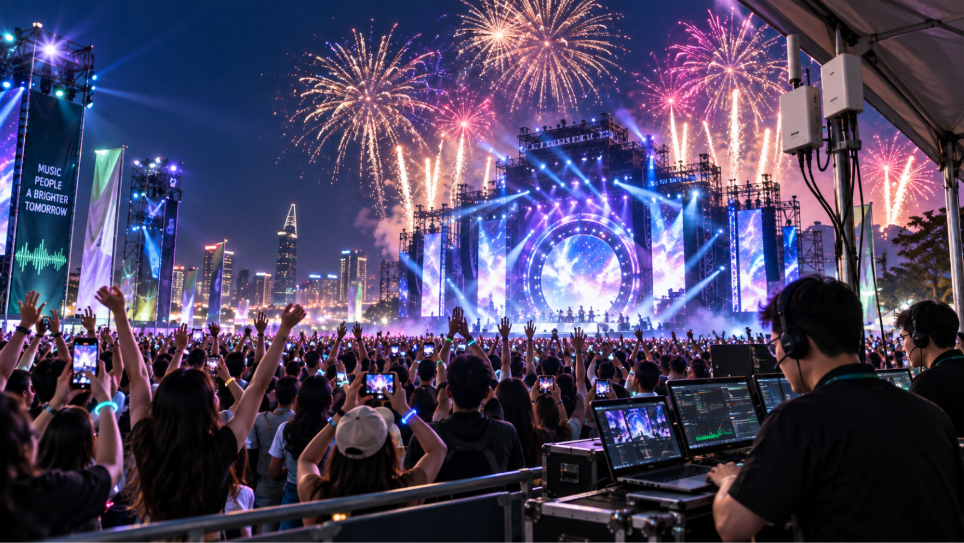
Unlike convention halls or hotels with existing telecommunications infrastructure, large-scale events such as music festivals or outdoor exhibitions are often held on open sites with large footprints, sometimes far from city centers. Stages, booths, check-in gates and F&B areas are temporary and may operate for only a few days. Event Internet and Wi-Fi therefore require detailed site surveys and a solution tailored to the actual venue layout - maintaining stability for critical operational traffic while remaining scalable and supported by a 1+1 technical redundancy plan for immediate risk response.
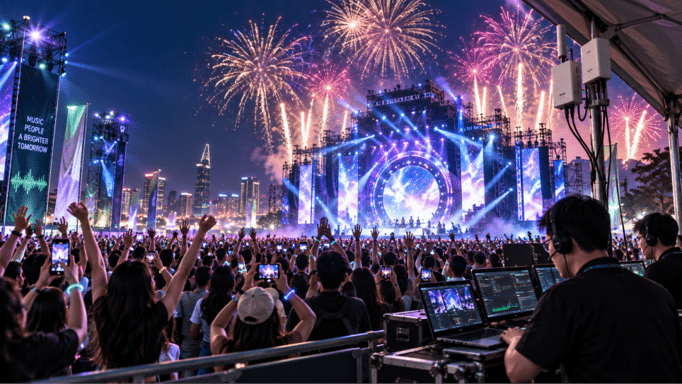
Internet and Wi-Fi for Outdoor Events Must Be Designed Around the Actual Venue Layout and Attendee Volume
At large-scale events such as concerts, festivals, and countdown celebrations, Internet connectivity is no longer a back-end support item. It becomes a core platform supporting both event operations and the attendee experience. The same network may need to support check-in, POS payments, program coordination, FOH (Front of House technical control), interactive activities and Internet access for a large audience at the same time.
Compared with indoor events, outdoor programs typically involve more variables in venue layout, attendee density, functional-zone placement and deployment conditions. Internet and Wi-Fi should therefore be surveyed and planned early, so the solution can adapt to the event itself rather than addressing issues only after live operations begin.
Network Segmentation Helps Protect Critical Operational Traffic
Within a single event, different user groups have different connectivity requirements in terms of usage, priority, and tolerance for disruption. Rather than applying one configuration across the entire venue, the network should therefore be organized around distinct usage groups so resources can be allocated appropriately, cross-impact can be limited, and critical operational traffic can remain stable:
|
User group |
Requirements |
Recommended approach |
|
Attendees |
Internet access, social media and participation in interactive event activities |
Strong coverage, capacity for high device concurrency and limited impact on the operational network |
|
Event Organizer |
Program coordination, internal communication and access to operational systems |
Dedicated or prioritized connectivity, maintained reliably during peak periods |
|
Booths / activation areas |
Product demonstrations, POS operations, registration and activation activities |
Connectivity delivered at the required location, aligned with device needs and stable as traffic increases |
|
Event systems |
E-ticketing, check-in, livestream, voting and related applications |
Prioritized bandwidth, appropriate network separation and a backup plan |
|
Technical team |
Event operations, FOH, control equipment and system monitoring |
Stable connectivity that is easy to monitor and troubleshoot when issues arise |
Segmentation reduces the risk that a traffic surge from one user group will affect other systems. However, increasing bandwidth addresses only part of the challenge; overall performance also depends on whether resources are allocated to the right location, user group, and point in time.
Based on this allocation model, each connectivity layer should also be selected according to its role within the overall architecture:
- DIA: Serves as the primary Internet circuit for critical systems, suitable for workloads that require stable bandwidth, high control and clearly defined service-level commitments.
- Event Wi-Fi: Distributes connectivity across individual usage areas, with coverage, access-point density and configuration calculated according to device density, traffic demand and venue characteristics.
- 5G connectivity: Extends connectivity to areas where fixed cabling is difficult to deploy and can also serve as a backup option after signal quality and site capacity have been assessed.
These three connectivity layers serve different purposes but operate together within one architecture. When the primary circuit, distribution layer, and supplemental or backup connectivity are clearly planned, the network can adapt more effectively to changes in traffic demand and live operational conditions.
From Operational Requirements to Deployment with NetNam
With its technology capabilities and event-service ecosystem, NetNam starts with the Event Organizer’s real operational requirements and translates them into a solution aligned with the event scale, venue layout, and program scenario.
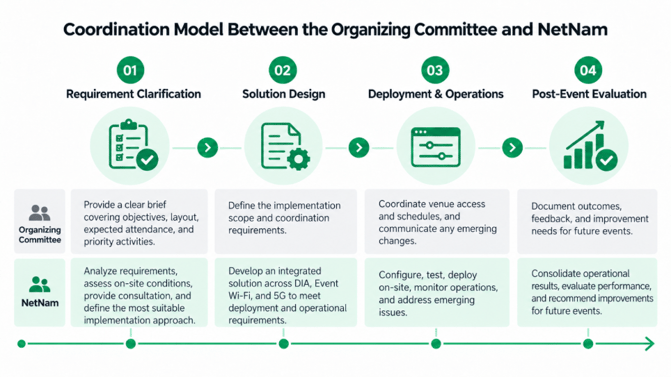
When operational requirements are translated into the right connectivity design and managed continuously from preparation through show day, the Event Organizer can respond more proactively to real-world changes. This also provides the foundation for stable operations, seamless interaction points, and a more consistent attendee experience.
Hotline: 1900 1586
Email: marketing@netnam.vn
Website: https://netnam.com/
NETNAM CORPORATION - 30 years of trusted network solutions and information technology services for enterprises
Head Office: 2nd Floor, HITC Building, 239 Xuan Thuy Street, Cau Giay Ward, Hanoi
Branch Office: 7 Nguyen Thi Minh Khai Street, Sai Gon Ward, Ho Chi Minh City
Representative Office: 2 Quang Trung Street, Hai Chau Ward, Da Nang




/Blog%20Post/ri_facebook-fill-white.svg)

