
Tài nguyên / Industry Perspectives
Tài nguyên / Industry Perspectives
Unit 42's 2026 report shows that the fastest 25% of intrusions reached the data exfiltration stage in just 1.2 hours, compared with 4.8 hours the previous year. An alert that appears at 2:00 a.m. could therefore develop into a serious incident before the business day even begins. When the impact spreads to operational systems or customer data, an organization may face response costs, downtime, and recovery of resource requirements at the same time. Detection, response, and recovery should therefore be treated as continuous operational capability.

When Technical Disruption Becomes Business Loss
The consequences extend beyond technical costs. When an ERP platform, payment system, or production line is affected, an organization may have to pause transactions, switch to manual operations, and work through a growing backlog. Additional costs may also arise from investigation, specialist support, data recovery, and system testing. If the incident involves data or affects service commitments, the organization may also face compliance risks and reputational damage.
For this reason, "every hour of downtime" is not simply losing revenue. The cost also depends on which systems are affected, when the incident occurs, and how long it takes to return to safe operations. The longer detection and remediation take, the greater the risk of higher costs, a broader impact, and an extended recovery period.
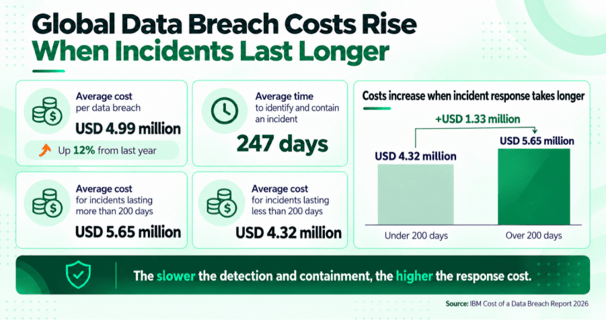
To reduce the impact of an incident, organizations should:
NIST CSF 2.0 - A Reference Framework for End-to-End Cybersecurity Capabilities
The NIST Cybersecurity Framework (NIST CSF) 2.0 is a cybersecurity guidance framework developed by the U.S. National Institute of Standards and Technology (NIST), with contributions from businesses, government agencies and cybersecurity professionals. It is a voluntary framework built around 06 functions that are carried out in parallel and continuously, helping organizations standardize how cybersecurity activities are organized, measure effectiveness, and improve risk response capabilities. NIST CSF 2.0 also provides a common reference point for business leaders, IT teams, and cybersecurity teams to assess organizational readiness together.
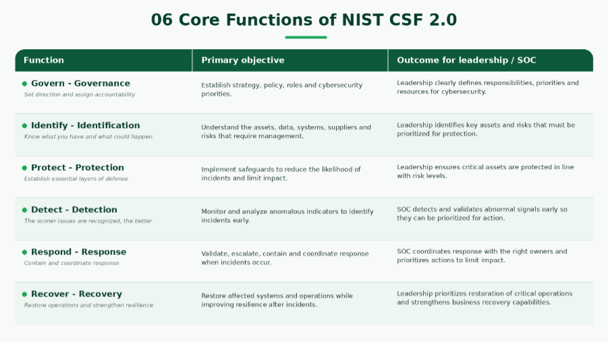
According to Palo Alto Networks, NIST CSF 2.0 is particularly useful for common cybersecurity challenges that organizations face today:
Globally, many large enterprises use NIST CSF as a reference framework to standardize and strengthen cybersecurity capabilities, including SAP. SAP began implementing NIST CSF in 2019 and achieved enterprise-wide Tier 3 - Repeatable status by the end of 2023. This indicates that cybersecurity risk management activities had been standardized into policies and processes and applied consistently across the organization, rather than depending on isolated practices within individual teams. Applying NIST CSF also gave SAP clearer visibility into risk across management levels and improved coordination between IT and business units.
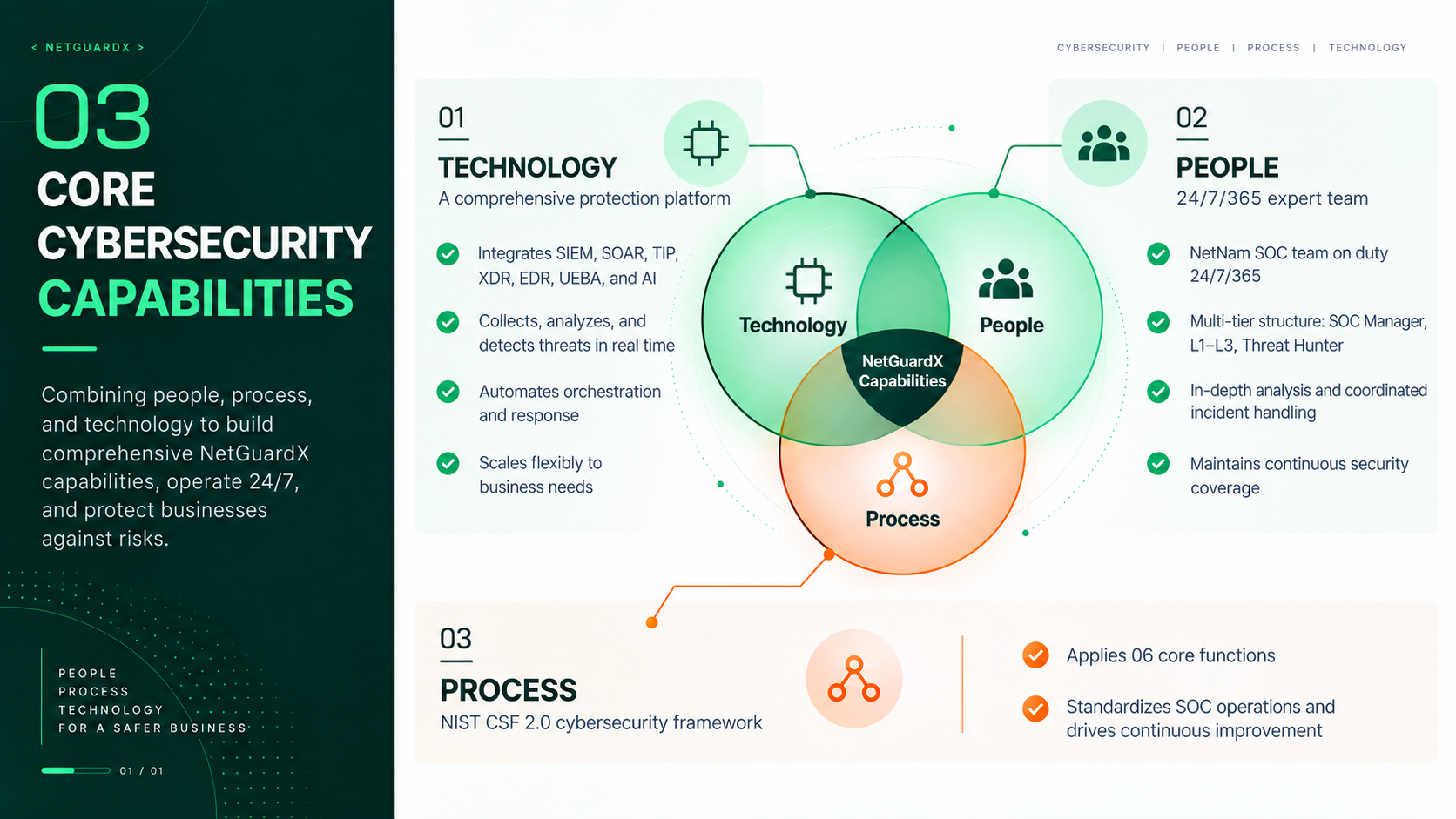
NetGuardX Supports Organizations Across 03 Core Cybersecurity Capability Pillars
The biggest gap is often not whether an organization understands the theory, but how that theory is translated into operational capabilities that can be sustained every day. To support continuous monitoring, early detection and response across the risk lifecycle, NetGuardX brings together 03 core capability pillars: people, process and technology.
When these 03 pillars operate in sync, organizations can shorten the path from alert to validation and response. This provides a foundation for limiting the scope of impact, prioritizing recovery for the right systems, and reducing the risk that a technical incident develops into prolonged business disruption. Talk to our expert!
Act Before an Incident Disrupts Operations
Organizations cannot predict exactly when a cyberattack will occur, but they can proactively strengthen their cybersecurity capabilities.
The first step is to assess the current cybersecurity posture and identify gaps across people, process and technology, then build an improvement roadmap aligned with the organization's risk profile and operational objectives. From there, investment budgets can be planned by priority, focusing first on systems and controls with the greatest business impact while allocating costs in phases rather than spreading investment too broadly. This approach helps balance protection requirements, financial capacity and operational effectiveness, while creating a basis for measuring outcomes and adjusting budgets as risks change.
Hotline: 1900 1586
Email: marketing@netnam.vn
Website: https://netnam.com/netguardx
NETNAM CORPORATION – 30 years of trusted internet & managed IT solutions and services for businesses
Headquater: 2nd Floor, HITC Building, 239 Xuan Thuy Street, Cau Giay Ward, Hanoi
Ho Chi Minh City Branch: 7 Nguyen Thi Minh Khai Street, Sai Gon Ward, Ho Chi Minh City
Representative Office: 2 Quang Trung Street, Hai Chau Ward, Da Nang
Reference:

Doanh nghiệp của bạn mất bao lâu để phát hiện một cuộc tấn công? NetGuardX đánh giá hiện trạng và bàn giao đề xuất lộ trình giám sát trong 5 ngày làm việc.
Đặt lịch đánh giá