Tài nguyên / Manufacturing
Tài nguyên / Manufacturing
A cybersecurity vulnerability is a weakness in software, equipment or system configuration that can be exploited to gain unauthorized access, alter system behavior or disrupt operations. Organizations may identify these weaknesses before an incident occurs through vendor advisories, notifications from cybersecurity authorities, periodic assessments, or security reviews requested by parent companies and customers. In a manufacturing environment, however, identifying a vulnerability does not always mean it can be fixed immediately.
Systems supporting production lines often operate within tightly controlled environments, where even a routine software update or configuration change may require compatibility testing, vendor coordination or a planned maintenance window. Applying a fix too quickly can introduce a different kind of risk: instability or downtime in systems that production depends on. This creates an important window between vulnerability discovery and full remediation. During that period, organizations need to reduce the immediate exposure while continuing to work toward a permanent fix. That means setting the right priority, applying interim controls where appropriate, and maintaining visibility over the affected environment until remediation is complete.
Vulnerability Remediation Has to Account for Operational Constraints
Manufacturing systems are different from conventional office IT. Many of them directly support the control, monitoring or continuity of production processes. As a result, even a relatively small change to software or configuration can have implications for compatibility, system stability or an established production schedule.
Before remediation is deployed, organizations may therefore need to assess how the change will affect connected systems, coordinate with relevant technology vendors and identify a suitable implementation window. For business-critical systems, teams may also need a rollback plan so that the system can be returned to its previous state if the change does not perform as expected.
This is why remediation decisions in manufacturing cannot be based on technical severity alone. A vulnerability may be rated as highly severe, but the remediation path still needs to consider the role of the affected system in production, the actual exposure of that system and the operational risk introduced by the change itself. Bringing these factors together helps organizations decide which vulnerabilities require immediate action and which can be temporarily controlled until remediation can be implemented safely.
Prioritize Remediation Based on Impact and Available Controls
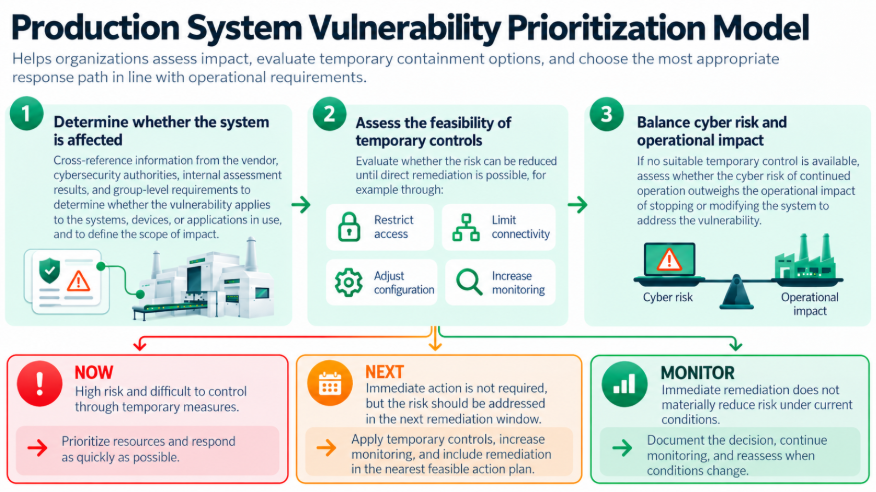
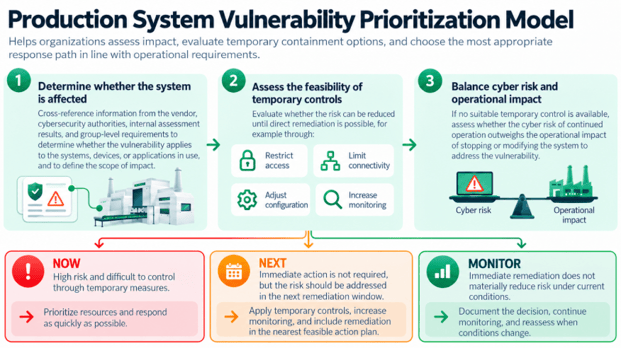
Once a vulnerability has been confirmed on a live system, the next question is not simply “How severe is it?” but “How much risk does it create in this specific operating environment?” The assessment should start with the role of the affected system in production and how exposed it is to external connections, user accounts or other environments.
From there, organizations can determine whether the immediate risk can be reduced through measures such as restricting access, limiting connectivity, adjusting selected configurations or increasing monitoring. This provides a more practical basis for prioritization. Rather than treating every vulnerability according to its technical rating alone, organizations can focus resources on issues with the greatest potential to affect production while applying appropriate controls to vulnerabilities that cannot yet be remediated.
A vulnerability that cannot be fixed today still needs to remain visible. Its risk level may change as new threat intelligence becomes available, operating conditions evolve or unusual activity appears around the affected system. When that happens, the remediation priority may also need to change. Continuous monitoring and coordinated response are therefore particularly important during this period. They allow organizations to reassess exposure as conditions change and maintain control until the permanent remediation can be completed.
NetGuardX Extends 24/7 Monitoring and Coordination During Remediation
NetGuardX provides 24/7 cybersecurity monitoring, bringing together signals from accounts, devices, network connections and critical systems to identify activity that may require further investigation.
When an issue is identified, NetGuardX specialists work with the organization’s internal teams to validate what is happening, assess the potential impact and escalate the response according to priority. This allows internal resources to remain focused on the vulnerabilities that require the most immediate attention while maintaining visibility across the wider environment.
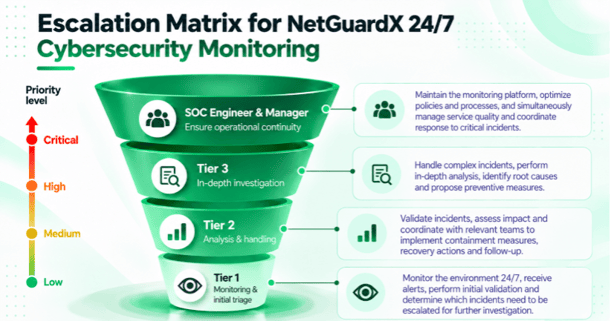
Acting as an extension of the internal IT team, NetGuardX adds specialist expertise and continuous monitoring capacity to support a more coordinated remediation process within the realities of day-to-day operations. The goal is not to push every vulnerability into immediate remediation regardless of operational impact, but to help the organization maintain visibility, prioritize effectively, and manage risk until the appropriate fix can be implemented.
Learn more about NetGuardX services!
Hotline: 1900 1586
Email: marketing@netnam.vn
Website: https://netnam.com/netguardx
NETNAM CORPORATION - 30 years of trusted internet and managed IT solutions and services for businesses
Head Office: 2nd Floor, HITC Building, 239 Xuan Thuy Street, Cau Giay Ward, Hanoi
Branch Office: 7 Nguyen Thi Minh Khai Street, Sai Gon Ward, Ho Chi Minh City
Representative Office: 2 Quang Trung Street, Hai Chau Ward, Da Nang

Doanh nghiệp của bạn mất bao lâu để phát hiện một cuộc tấn công? NetGuardX đánh giá hiện trạng và bàn giao đề xuất lộ trình giám sát trong 5 ngày làm việc.
Đặt lịch đánh giá